Wills, Heirs and the Fideicomiso: 7 Estate Planning Myths for Canadians Who Own in Mexico
By HomLista · · 4 min read
Does your Canadian will cover your condo in Mexico? Does the bank trust avoid probate? Seven common myths about inheriting Mexican property, what really happens when an owner dies, and the simple steps that spare your family months of paperwork.
Nobody buys a condo in Mexico thinking about who will inherit it. Yet this is where many Canadian families run into trouble: a will written in Canada, a bank trust signed in Spanish years ago, and heirs who discover the rules only after a death. Here are seven myths about estate planning for Canadians who own property in Mexico, and what actually happens.
Myth: My Canadian will covers my Mexican property.
Reality: a foreign will can be enforced in Mexico, but the process is rarely smooth, as this expat guide notes: translation, legalization and a court or notarial procedure in Mexico. For property held in a bank trust, the will is not what decides who inherits (see the next myth). For assets outside a trust, such as a house owned directly, a car or a Mexican bank account, a Mexican will is usually the simplest solution.
Myth: The fideicomiso automatically goes to my heirs.
Reality: only to the people you named. The trust contract lets you name substitute beneficiaries who take over when you die, and when it is set up correctly this avoids a court process, according to the Gringo Gazette. If you named no one, or named someone who has since died or divorced you, your heirs face a longer process. And your will does not override the trust, so the two should name the same people.
Myth: If I use a bank trust, there is nothing to pay or do.
Reality: the substitute beneficiaries still have paperwork. They present an apostilled and translated death certificate to the trustee bank, the bank requests a new permit from the foreign affairs ministry in their names, the property is appraised, and an acquisition tax is usually due. In the example cited by the Gringo Gazette, total costs came to about 3% of the appraised value.
Myth: Mexico has an inheritance tax.
Reality: Mexico has no inheritance tax as such. Heirs may still owe the local property acquisition tax, sometimes at a reduced rate for close family, plus notary and bank fees.
Myth: Canada doesn’t care about property abroad.
Reality: when a Canadian resident dies, the CRA generally treats their capital property, worldwide, as sold at fair market value just before death, unless it passes to a spouse or common-law partner. A Mexican condo can therefore create a capital gain on the final return in Canada, calculated in Canadian dollars. Your executor will need a cross-border accountant.
Myth: Inland properties work the same way as beach condos.
Reality: properties outside the restricted coastal and border zone, for example in San Miguel de Allende or around Lake Chapala, can be owned directly through a deed in your name, with no bank trust. That means no substitute beneficiaries: without a Mexican will, your heirs may need a full succession procedure in Mexico.
Myth: I can deal with this later.
Reality: updating trust beneficiaries is a request to the trustee bank, usually with a fee; a Mexican will is signed before a notario in a single appointment. Every September, during Mexico’s “Will Month” (Mes del Testamento), notaries offer reduced fees and easier appointments.
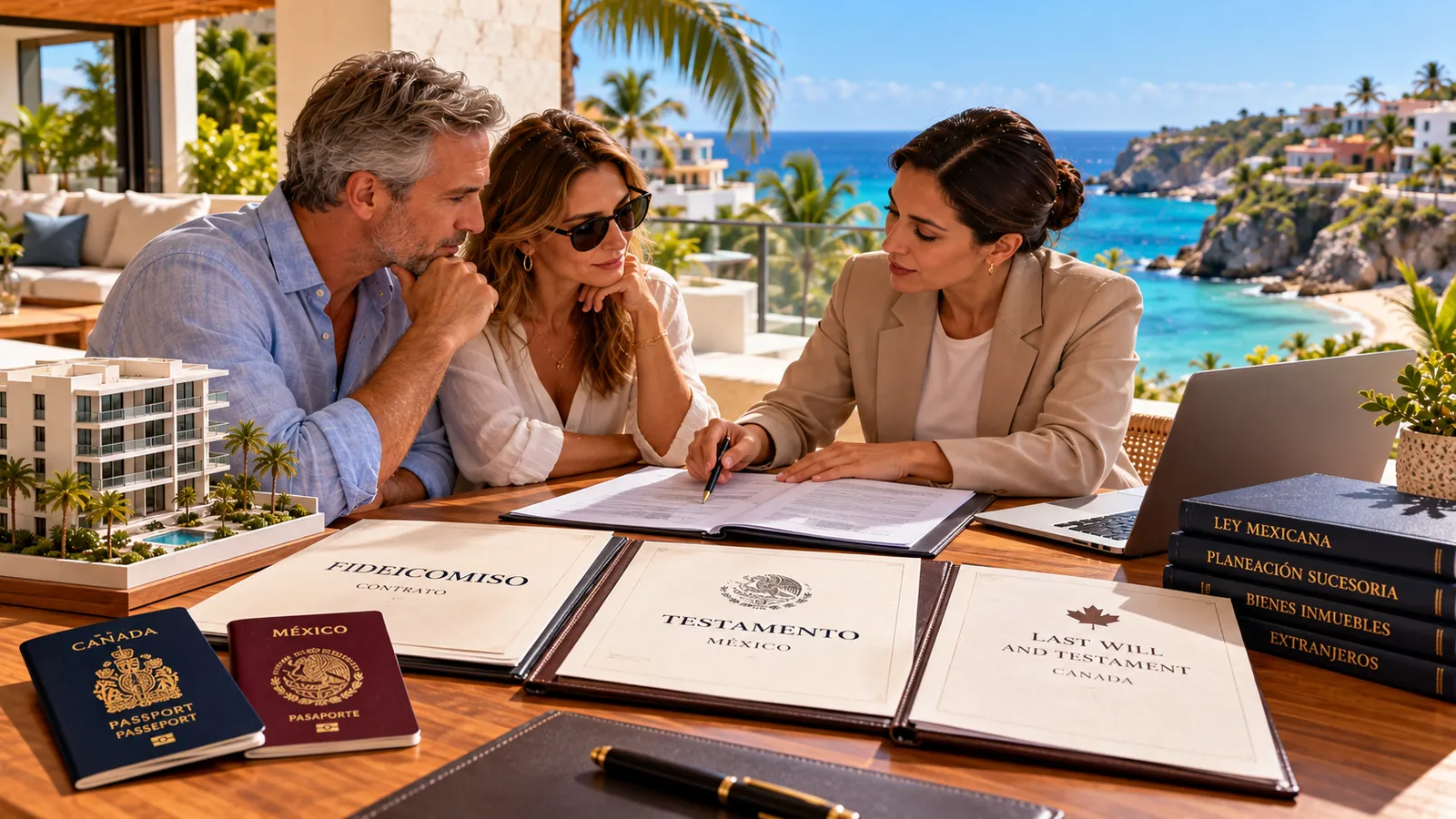
Two documents protect your heirs: a fideicomiso with up-to-date substitute beneficiaries, and a Mexican will for everything the trust does not cover. Make sure both name the same people as your Canadian will.
Your 15-minute review
Find your fideicomiso contract and check who is named as substitute beneficiary.
Confirm those people match your Canadian will, and update the trust if your family situation has changed.
List everything in Mexico not held in the trust: car, bank account, furniture, a directly owned house.
Book a notario for a Mexican will covering those assets.
Give your executor copies of the deed, trust contract, bank contacts and your Canadian accountant’s details.
New to the bank trust? Our Cancun buyer FAQ explains how a fideicomiso works, and our checklist for Canadian buyers covers the purchase from start to finish.
Updated October 2026. This article is general information only and is not legal or tax advice. Estate rules depend on your province, the Mexican state where the property is located and your family situation; consult a Mexican notario and a Canadian estate lawyer.