How Americans Pay for Property in Mexico: 5 Ways to Finance It, and How to Wire Money Safely
By HomLista · · 4 min read
Most Americans buy in Mexico with cash, but it is not the only option. Compare five ways to pay, from a HELOC on your US home to developer plans and Mexican mortgages, with costs and risks, plus the steps that protect your wire transfer.
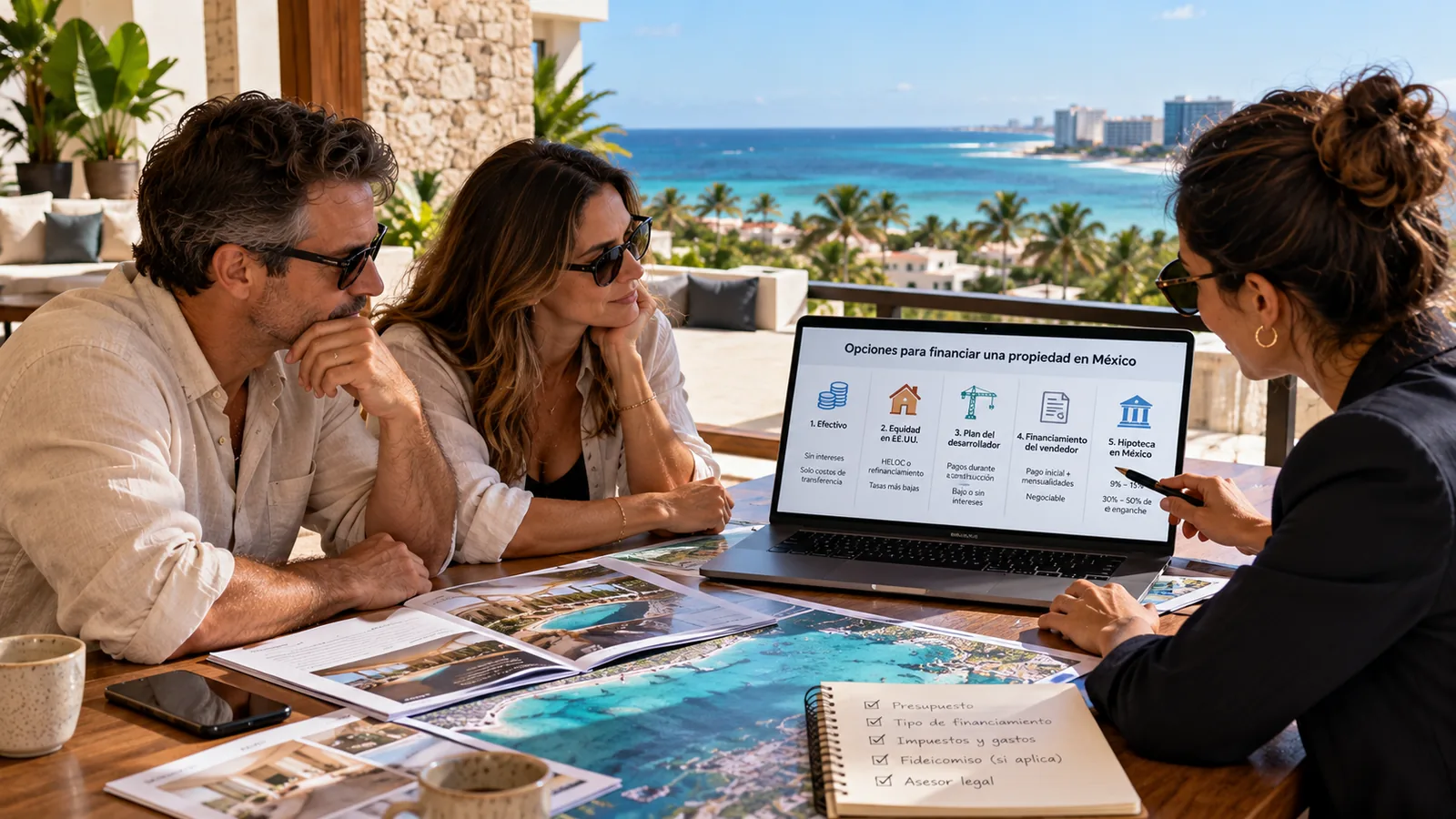
Americans looking at property in Mexico quickly discover that a US mortgage will not cover it: US lenders rarely lend against homes abroad. So how do Americans finance property in Mexico? There are five main routes, each with a different cost and a different risk. Here they are side by side, followed by the steps that keep your money safe on its way south.
The 5 ways to pay
1. Cash
Most Americans buying in Mexico pay cash, wired from a US account to the seller, the developer or an escrow account at closing.
Cost: no interest, only transfer and currency costs.
Main risk: a large sum concentrated in one asset, and the risk of wire fraud (see below).
Best for: buyers with savings or proceeds from selling a US home.
2. Borrowing against your US home
A home equity line of credit (HELOC) or a cash-out refinance on a US property turns your equity into cash you can then use in Mexico.
Cost: US home-equity pricing, usually well below Mexican mortgage rates for foreigners.
Main risk: your US home secures the loan, so a problem in Mexico becomes a problem at home.
Best for: owners with substantial equity and stable US income.
3. Developer payment plans
On pre-construction projects, developers often offer to spread the price over the construction period, sometimes with little or no interest.
Cost: often low or zero financing cost, but check whether the cash price is lower.
Main risk: if the project is delayed or never delivered, your payments are exposed to the developer.
Best for: buyers who have vetted the developer thoroughly and can wait for delivery.
4. Seller financing
Some private sellers accept a down payment and monthly installments. On coastal property this is typically structured through a guarantee trust (fideicomiso en garantía), which adds setup costs, as noted in this closing-cost guide.
Cost: negotiated rate and term, plus trust and notary fees.
Main risk: unclear contracts; have a Mexican lawyer draft the terms and the default conditions.
Best for: resale homes where the seller is not in a hurry for the full amount.
5. A Mexican mortgage
Mexican banks lend to foreigners, but usually only to temporary or permanent residents. International lenders that specialize in Mexico are more flexible on residency.
Cost: rates of about 9% to 12% with Mexican banks and 11% to 15% with international lenders, with 30% to 50% down, according to Lorad Law.
Main risk: high rates and, if the loan is in pesos while your income is in dollars, currency swings.
Best for: residents of Mexico, or buyers who cannot or do not want to use US equity.
The cheapest money for a Mexican property is usually American: cash or US home equity. Mexican financing exists, but you pay for the convenience.
Wiring money to Mexico safely
Real estate is a favorite target for wire fraud: criminals intercept emails and send buyers “updated” bank details just before closing. Protect yourself:
Confirm wiring instructions by phone, using a number you already know for the notario, escrow company or developer, never one from the email.
Treat any last-minute change of bank details as fraud until proven otherwise.
Pay only to companies, escrow or trust accounts, never to an individual agent’s personal account.
Send a small test transfer first for large amounts, and confirm receipt before sending the rest.
Keep every confirmation, with the date and exchange rate: you will need them for the deed and for US tax purposes when you sell.
Dollars or pesos?
Many resort-area properties are priced in US dollars, but taxes and notary fees are calculated in pesos. Compare your bank’s exchange rate with a specialist currency provider before converting a large amount: on a $300,000 purchase, a one-percentage-point difference in the rate is $3,000.
What you report to the IRS
Wiring money to buy property does not by itself create a reporting obligation for you. But if you open a Mexican bank account, for example to pay condo fees, and your foreign accounts together exceed $10,000 at any point in the year, you must file an FBAR; the IRS comparison of Form 8938 and FBAR explains the thresholds. Property held directly, or through a fideicomiso, is covered in our Cancun buyer FAQ.
Which option fits you?
You have cash or strong US equity: use it, and keep the Mexican purchase simple.
You are buying off-plan: a developer plan can work, but only after checking permits, title and the developer’s delivered projects.
You live in Mexico with residency: compare Mexican bank offers, including the total cost and currency.
You plan to rent it out: run the numbers with your real financing cost; our short-term vs long-term rental study shows how.
Ready to look? Browse condos for sale in Cancun and in Playa del Carmen, or read our Los Cabos area guide (listings are in Spanish).
Updated October 2026. Rates and terms change frequently; ask each lender for a written quote. This article is general information, not financial or tax advice.